Recently, a check-in app in China went viral with a confronting name: “Are You Dead?”
Blunt. Shocking. Impossible to ignore.
And it worked — because it touched a nerve that exists well beyond China.
More people than ever are living alone.
Across the world, solo living is rising. People are choosing independence, autonomy, and space — whether by circumstance or design. And while living alone can be empowering, it also comes with a quiet, often unspoken question:
If something went wrong… how long would it take for someone to know?
The popularity of an app called “Are You Dead?” wasn’t about shock for shock’s sake. It was about that underlying fear — the fear of being unseen for too long.
The problem is real. The approach doesn’t have to be loud.
Here in Australia, we recognised the same problem.
But we believed the solution didn’t need shock value, drama, or constant monitoring.
Solo Alert was built on a very different mindset:
that people living alone deserve reassurance without intrusion.
That a safety net shouldn’t make you feel watched, dependent, or diminished.
And that independence matters.
Why Solo Alert exists
Solo Alert was created after our founder lost two friends in their 40s who lived alone.
One wasn’t found for days.
The other was discovered unconscious, too late for early intervention.
Both deaths raised the same heartbreaking question:
Would something simple have changed the outcome?
Not a nurse.
Not a monitoring service.
Not a constant check from family or friends.
Just a simple moment where someone noticed, “I haven’t heard from them.”
Solo Alert was born from that question.
A check-in, not a surveillance system
Solo Alert is intentionally simple.
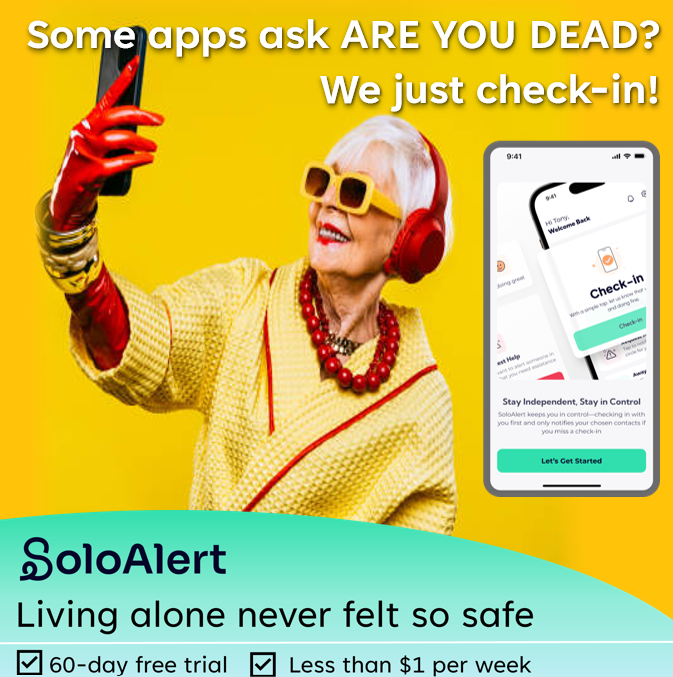
Users check in — usually twice a day — in under ten seconds. That’s it.
No one is watching you.
No one is tracking your movements.
No one is notified unless a check-in is missed.
If you don’t check in, only then does Solo Alert quietly activate your chosen safety net.
It’s not about predicting emergencies.
It’s not about replacing independence.
It’s about making sure silence doesn’t go unnoticed.
Independence comes first
One of the biggest fears people have when considering safety tools is losing autonomy.
They don’t want to feel like a burden.
They don’t want to be monitored.
They don’t want their independence questioned.
We hear this again and again.
That’s why Solo Alert is built around a simple principle:
A safety net doesn’t mean giving up your independence.
You live your life exactly as you choose.
Solo Alert just sits quietly in the background — doing nothing unless it’s needed.
A quieter Australian approach
Australians tend to value straight-talk, yes — but also fairness, dignity, and personal space.
Solo Alert reflects that.
It’s practical.
It’s calm.
It’s unobtrusive.
And it respects the fact that people who live alone are not fragile — they’re independent.
They just deserve a backup plan.
Reassurance doesn’t need to be loud
You don’t need a dramatic app name to feel safe.
You shouldn’t need constant oversight to live independently.
And you shouldn’t need to explain your choice to live alone.
Solo Alert exists for one simple reason:
So that if something does go wrong, someone knows sooner — not days later.
Quietly.
Respectfully.
And only when it matters.
💚